








Dedoku: Detective Sudoku

Sudoku meets real clues!

Place the suspects using the clues and find the culprit. 300 free cases and a gripping story are already in the game. New cases and puzzles come out every few months.

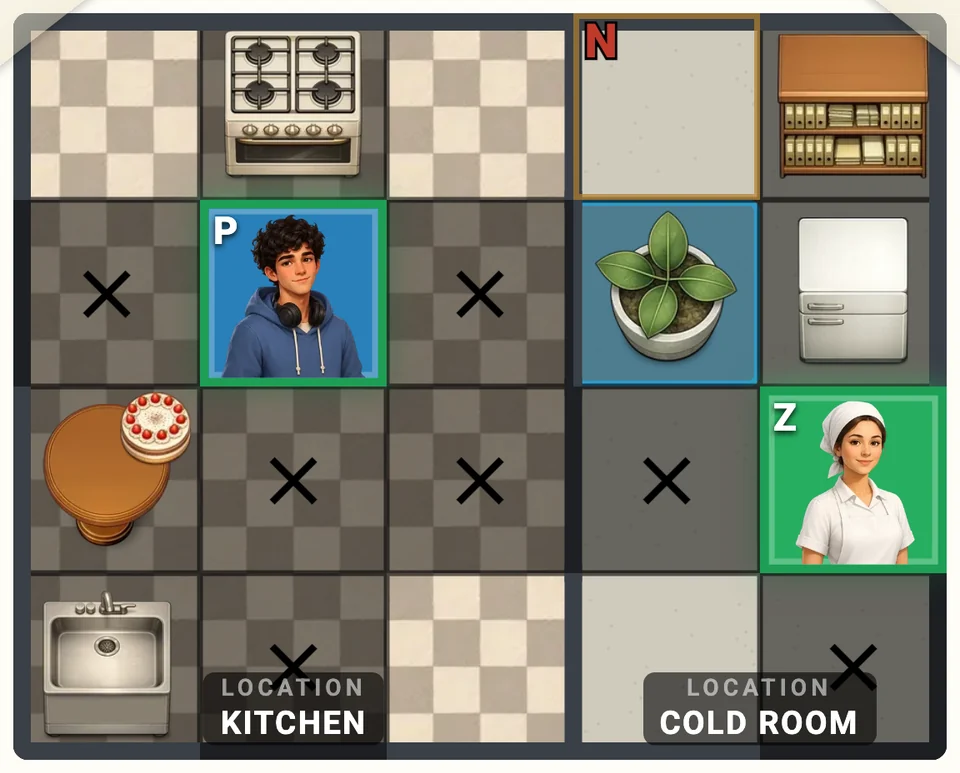
The case “Who Ate the Cake?”: two suspects are already in their spots, and Neil has one cell left, beside the ficus—it’s marked with the letter “N” Neil’s suspect card with the clue “Was beside the ficus.”
What makes Dedoku different from sudoku

What is Dedoku

“Dedoku: Detective Sudoku” is a sudoku-style puzzle with a real story. Each case is a map of the crime scene, divided into cells and locations: a kitchen, a living room, a garden. There’s furniture on the map, and next to it are the suspect cards, each with its own clue: where the person was and what they were beside.

Place everyone so that every clue fits—and the culprit comes to light on their own. Pure logic: no luck, no guessing, no timers. Every case has exactly one solution.

Story: “Wedding of the Century”

Wedding planner Jenna brings you to tycoon Victor Grin: his daughter Lisa is getting married, and for a month of celebrations the family needs the best detective in the city. The job looks trivial: a missing boutonniere, an eaten cake, the usual pre-wedding fuss.

But at the banquet rehearsal, the toastmaster drops dead in the middle of a toast. The doctor says it was his heart, and the police close the case. Only the detective feels it all fell into place a little too neatly.

Ahead lie the Wedding Express, a mountain hotel and a private island. Twenty days, a hundred story cases and guests who all have something to hide. This is the detective’s first notebook—and only the beginning of his story.

  • An evening street in the old town with a café and streetlamps
    Act I · The City
  • A platform at night: a journalist with a camera by the Wedding Express
    Act II · Wedding Express
  • The lobby of a mountain hotel with a fireplace and a view of the mountains
    Act III · Mountain Hotel
  • The pier of a private island at sunset
    Act IV · Private Island

What makes Dedoku different from sudoku

The framework is familiar: each row and each column of the map holds only one person—like a digit in sudoku.

But instead of digits there are people, instead of an empty grid there are locations with furniture, and instead of given numbers there are clues: “was beside the stove,” “was alone in her location,” “to the right of the fireplace,” “in the same location as Vera.” Every clue is true. Put them together, and each suspect is left with just one spot.

The same map in Dedoku, with people and furniture

How to Play

In each case, your goal is to place all the suspects in cells on the map so that every clue fits. Once everyone is in their spot, the culprit comes to light on their own—just like in a real investigation.

  1. Mark the options. Pick a suspect’s card and tap the cells where they could have been—pencil marks with the first letter of their name will appear.
  2. Test your hunch. When someone has only one spot left, press and hold that cell. If your hunch is right, the suspect is placed there.
  3. Watch the map. Cells where no one can be anymore are crossed out automatically—with every step, the map gets clearer.
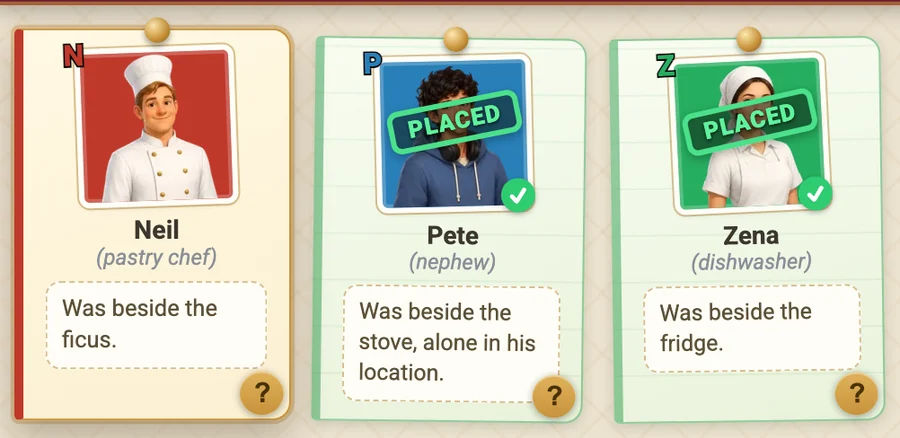
Suspect cards with clues: Neil, Pete and Zena

Three tries per case

In each case you have three magnifiers—three tries. A wrong test breaks one magnifier; break all three, and the case starts over. Pencil marks cost nothing: add and erase them as much as you like.

Stuck? Use a hint: it reveals where one of the suspects was. You get a few hints at the start, plus more for free every day and for completing tasks.

Detective techniques

Start with the most specific clues, mark every option and rule out the extras—the chain of deductions will lead you to the culprit. In tough cases, these techniques come in handy:

  • Pointing line. If every cell where a person could be lies in one row or one column, that line is theirs. Everyone else can be crossed out of it.
  • Counting spots. A location one column wide holds only one person. If someone has to be there, no one else can go in.
  • By contradiction. Try placing a person in a cell: if someone else is then left with nowhere to go, that cell won’t work.

What’s in the game

  • A story campaign in four acts with illustrated scenes and a big twist.
  • A Notice Board with dozens of extra cases.
  • Suspects with their own portraits and personalities.
  • Difficulty ramps up smoothly: new kinds of clues and new techniques unlock step by step.
  • Detective level, tasks and ranking.
  • Hints for when a case hits a dead end.
  • 12 languages; play on computer, tablet or phone.

For fans of Murdoku, Meowdoku and Murdle

If you love Murdoku, Meowdoku, Murdle and whodunit logic puzzles, Dedoku is made for you. It has the same joy of pure deduction, but with a big story: the cases are connected, and anything at the wedding of the century, however small, may be hiding something more.

Start investigating

Questions and answers

Is it free?

Yes. Every case can be solved for free. The game’s shop has hints and the “Sheriff’s Badge”—they help, but you don’t need them.

Do I need to sign up?

No, you can start playing right away. Sign in with VK ID, Yandex ID or email to save your progress and open it on any device.

Where can I play?

In the browser on your computer, tablet or phone. There’s nothing to install.

How many cases are in the game?

300 free cases: the story cases of the four acts plus extra cases on the Notice Board.

How is Dedoku different from sudoku?

In sudoku you place digits; in Dedoku you place people. The framework is the same: no more than one per row and per column. And instead of given digits there are clues: who was where and what they were beside.

What if I can’t solve a case?

Use a hint: it reveals where one of the suspects was. You get a few hints at the start, plus more for free every day and for completing tasks.

What languages can I play in?

12 languages: Russian, English, German, Spanish, French, Italian, Portuguese, Turkish, Arabic, Hindi, Indonesian and Japanese.

How often do new cases come out?

New cases and puzzles come out every few months.